
A new open pool has been formed with the Chinese EV manufacturer XPeng.
Schmidt Automotive ResearchAccording to reports, Porsche will leave the Volkswagen Group's CO₂ pool and form a new open pool with Chinese EV manufacturer XPeng for 2026 and 2027.
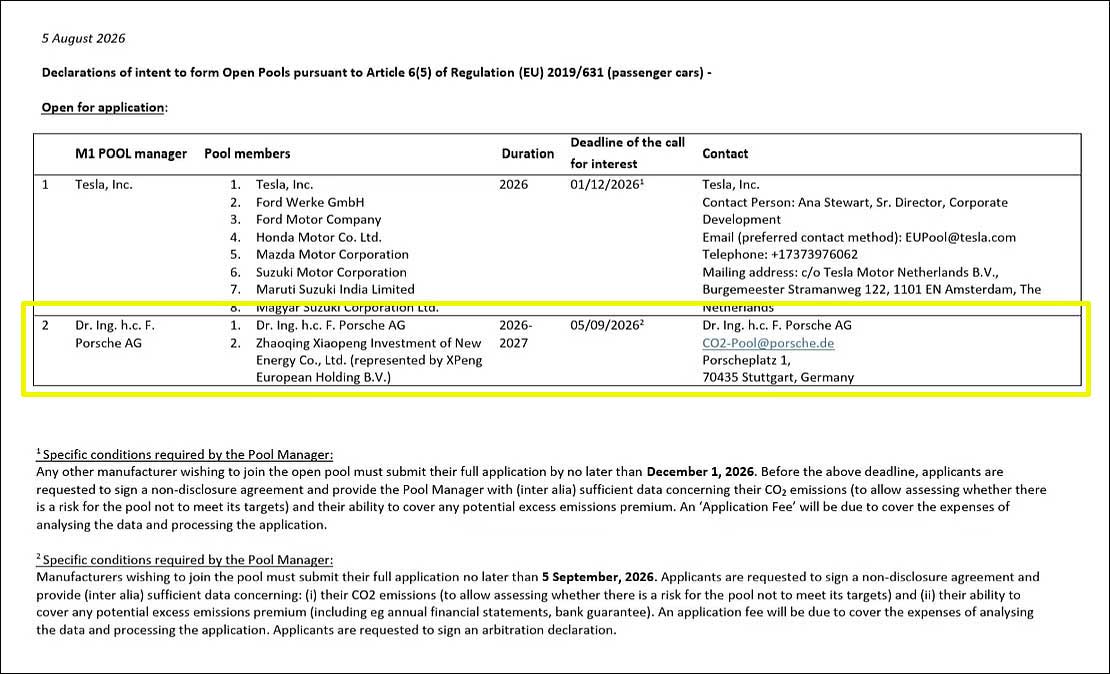
The basis for that report is a document dated August 5, 2026, titled "Declarations of intent to form Open Pools," which indeed lists "Dr. Ing. hc F. Porsche AG" as the pool manager and the following two companies as pool members.
- Dr. Ing. hc F. Porsche AG
- Zhaoqing Xiaopeng Investment of New Energy Co., Ltd. (represented by XPeng European Holding BV)
The period is 2026-2027.
What is a CO₂ pool?
In the EU, car manufacturers are required to set CO₂ emission targets for new cars they sell, and one of the methods recognized for achieving these targets is "pooling."
Simply put, it's a system where multiple automakers form teams, and compliance with regulations is judged based on the average CO₂ emissions of the entire team.
Therefore, even manufacturers that sell cars with high CO₂ emissions can lower the average CO₂ emissions of the entire pool by partnering with manufacturers that sell a lot of EVs.
Porsche and Xiaopeng are separate companies, so how can they team up?
Until I saw this news, I hadn't really looked into CO2 pools seriously, so my first thought was, "Wait, Porsche and Xiaopeng aren't even part of the same group of companies, so how can two companies just suddenly put together a pool like that?"
Apparently, this can be assembled. It's permitted under EU regulations.
Article 6 of EU Regulation (EU) 2019/631 stipulates that automakers can form pools to jointly achieve CO₂ targets.
Pools of manufacturers not belonging to the same corporate group are also envisioned, and in such cases, compliance with competition laws, as well as open, transparent, and non-discriminatory participation conditions, are required.
If you look closely at the image of the document I showed earlier, you'll see that "Porsche and Xiaopeng" is listed in the Porsche pool, but it's an "open pool" where other car manufacturers can also apply to participate.
The deadline for applications to join the CO₂ pool team, where Porsche serves as pool manager, is September 5, 2026.
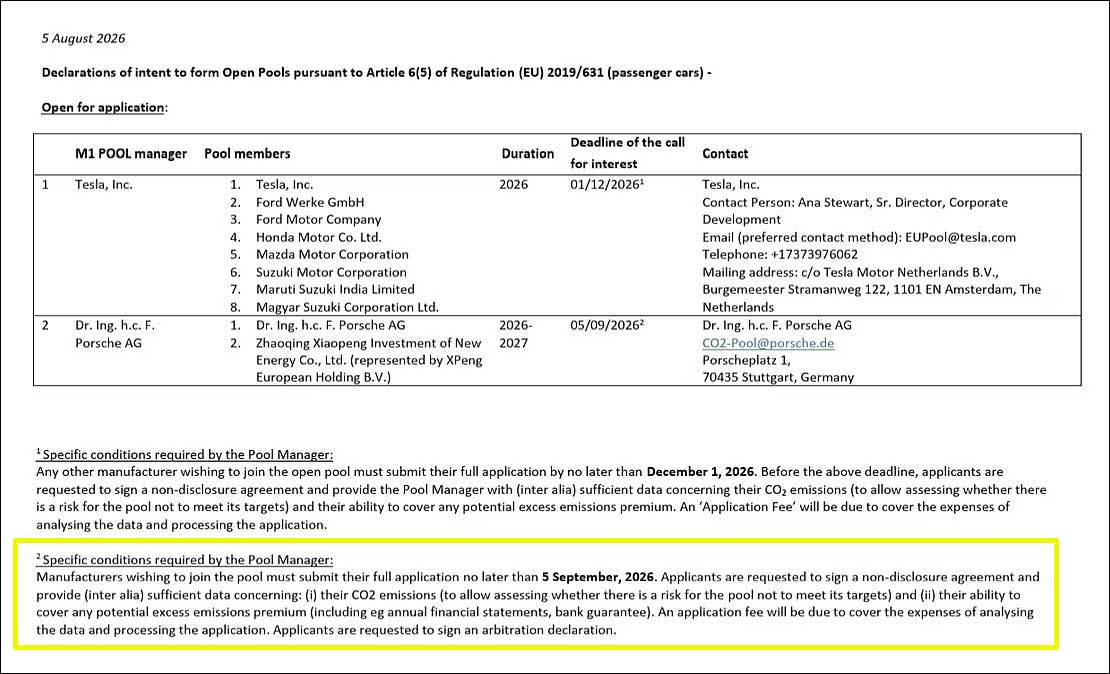
Therefore, at this point, we cannot rule out the possibility of other manufacturers joining the market.
Why is Porsche partnering with Xiaopeng?
According to Schmidt Automotive Research, Xiaopen sold just under 20,000 units in 18 Western European markets in the first half of 2026, and could reach nearly 50,000 units in the region for the entire year of 2026.
On the other hand, as you all know, Porsche is struggling with BEV sales.
Since Xiaopeng is a manufacturer of electric vehicles (EVs), if we consider Xiaopeng as part of the same CO₂ pool as Porsche, which has relatively high CO₂ emissions, we can expect it to have the effect of lowering the average CO₂ emissions of the entire pool.
So the goal is precisely to reduce average CO₂ emissions, right?
Why haven't you teamed up with Xiaopeng until now?
I think I understand now why Porsche is partnering with Xiaopeng and Pool.
But the question here is, why hasn't Porsche partnered with an EV manufacturer like Xiaopeng sooner?
Porsche hasn't given any official explanation for this, so this is just my own speculation, but I think the reason is that the circumstances surrounding Porsche have changed from before.
Since Porsche originally planned to significantly increase sales of electric vehicles, I think at the time they were probably thinking, "Increase the number of our own EVs to lower the average CO₂ emissions."
However, that hasn't gone well, and as a result, Porsche is now reviewing its product strategy and shifting towards keeping ICE (internal combustion engine) and PHEVs in the lineup for longer than originally planned.
Therefore, this strategic revision suggests that they have shifted their focus from "reducing the average CO₂ emissions within their own company" to "collaborating with EV manufacturers to reduce the average CO₂ emissions."
Benefits for the VW Group as well
Furthermore, while the Volkswagen Group's CO₂ emissions were projected to average around 100g/km in 2025, compared to the EU's target of 93.6g/km, it is analyzed that the removal of Porsche, which has relatively high average CO₂ emissions, from the VW Group's pool will make it easier for the VW Group to meet its regulatory targets.
In other words:
- Porsche: Partnering with Xiaopeng will make it easier to lower average CO₂ emissions.
- VW Group: Removing Porsche, which has high CO₂ emissions, from the pool will make it easier to improve the average.
This could potentially create a situation that benefits both Porsche and the VW Group.
Benefits for Xiaopen as well
So, will Xiaopeng be unilaterally helping Porsche? According to reports, Xiaopeng is said to be receiving economic benefits from complying with regulations as a result of this agreement.
However, details such as the specific financial arrangements and the amount involved have not been revealed.
Incidentally, the VW Group and Xiaopeng are not entirely unrelated; it has also been reported that the VW Group owns approximately 51 TP1T of Xiaopeng's shares.
Does this mean Porsche can now produce more cars with internal combustion engines (ICE)?
This pool team formation will allow Porsche to calculate its CO₂ emissions together with those of Xiaopeng's EVs, thus averaging Porsche's CO₂ emissions across the entire pool.
This naturally leads to the hope that "if that's the case, Porsche will be able to increase the proportion of ICE (internal combustion engine) cars they sell in the future."
However, since there is no mention yet of anything like "we can now produce more ICE cars by teaming up with Xiaopeng," I can't make any definitive statements, but I do think there's a little reason to be optimistic.
For now, all we've been able to confirm is that Porsche has expressed its intention to form an open pool with Xiaopeng for 2026-2027.
This is quite an interesting development, isn't it?
Source:
◆XPeng to benefit from Porsche EU CO₂ regulatory credits as the German sports-car company exits VW Group pool
◆EU official: Regulation (EU) 2019/631 (EUR-Lex)Article 6 Pooling
◆Porsche leaves VW Group emissions pool to partner with China's Xpeng for 2026-27
I'm Rika, the author of this article. Since I got my hands on a Porsche 911, I've been completely hooked on Porsches and I can't stop loving them, so I started this blog. My favorite cars are the 911 Carrera (2/991), 911 Carrera Cabriolet & 911 Carrera T (1/992), GT3 (1/997) and 718 Cayman GT4 RS.
 English
  Japanese