
Porsche Heritage Moments
In 2026, 50 years after the Porsche 935 received type approval in March 1976, Porsche is commemorating "Porsche Motorsport 75th Anniversary" by releasing a retrospective video about the Porsche 935, which dominated domestic and international racing series, including the World Manufacturers' Championship, since 1976.
This is a five-part series titled "Porsche Heritage Moments," in which Timo Bernhard and Norbert Singer provide the first detailed explanation of the history of the 935.
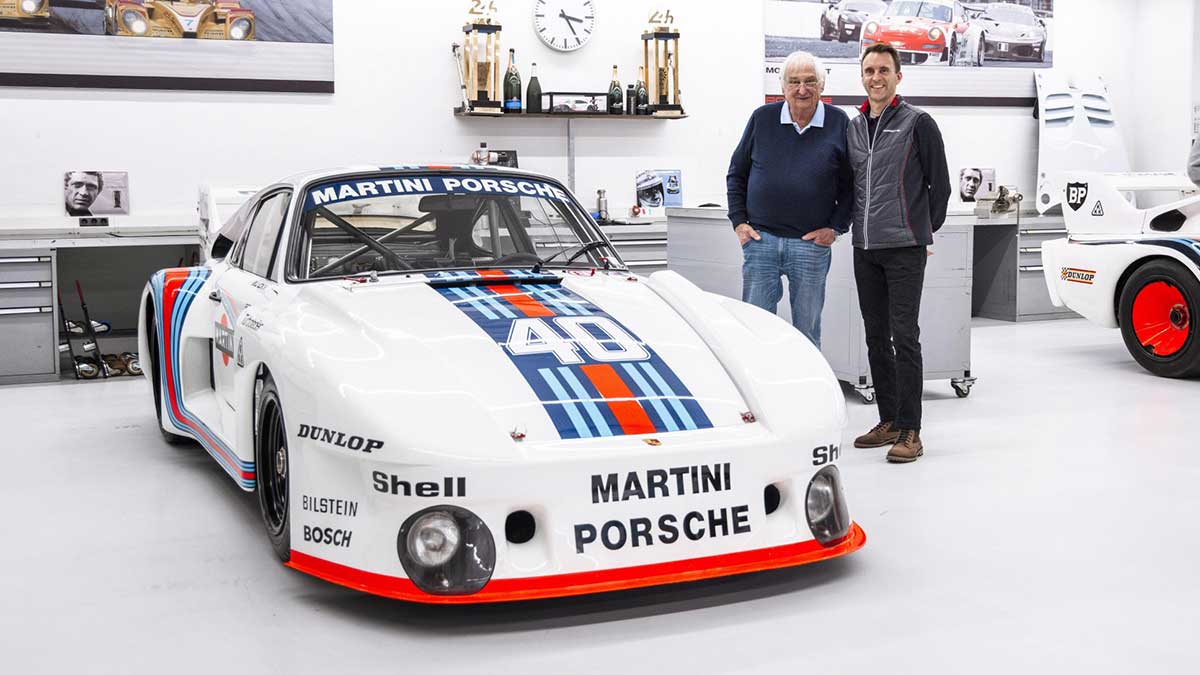
Timo Bernhard, a Le Mans winner and World Endurance Championship champion, has invited former race engineer Norbert Singer to guide him through each episode.
This will be the first time that the five key stages of evolution of the Porsche 935 will be presented together.
The following will be introduced:
- The first officially licensed model from 1976.
- Further improved 935/77
- The compact 935 "Baby"
- The innovative 935/78 "Moby Dick"
- An in-house developed prototype later used in bicycle record attempts.
These five cars clearly demonstrate how rapidly the concept has evolved year after year, and their pioneering spirit is said to reflect the brand's core identity.
Each video is about 20 minutes long, so if you have some free time and are interested, why not take a look?
1: It all began: 1976 Porsche 935
The Porsche 935 was developed based on the Porsche 911 and designed for the then-newly established Group 5 category. It was shaped in a way that left room for interpretation of the regulations, while simultaneously pushing the limits of those regulations.
A rethinking of wide fenders, a controversial engineering solution, and a concept that maintains a clear and distinctive identity across all variations.
In this first part of the video, Singer reflects on the rigorous technical inspections conducted by the FIA, where he had to defend every bodywork element, and discusses the cockpit designed for quick adjustments.
There was also a discussion about the importance of communication between drivers and teams in an era before radio communication with the pit lane.
2: 935/77: Evolution through twin-turbo technology
Part 2 will be a look back at the 1977 Le Mans race, focusing on endurance, aerodynamics, speed, and lap times.
This includes details about the new bodywork, the relocated mirrors on the front fenders, and the resulting restricted visibility. The author also explains, from the perspective of a race engineer and aerodynamics expert, the areas where edges have been smoothed to improve downforce.
Regarding the twin-turbo engine, which was the biggest change from the 1976 model to the 1977 version, etc.
3: The 935 "Baby" is specially lightweighted for sprint races.
Part 3's theme is the courage to simplify.
Porsche says the 935 "Baby" is based on the larger 935, but "everything that isn't absolutely necessary has been removed." They apparently scrutinized every single part and questioned its purpose.
This reportedly includes removing the seat adjustment function and even drilling a hole in the ignition key.
The underbody was replaced with an aluminum frame, steel disappeared, and rigidity was reconsidered, resulting in a chassis that weighs below the minimum required.
4: Extreme Episode: 935/78 "Moby Dick"
The 935/78, which would later be nicknamed "Moby Dick" after being unveiled to the public in 1978, was already two seconds faster than other cars in practice runs for the 6-hour endurance race at Silverstone, and went on to win the World Championship race with an overwhelming lead.
The technical foundation is a 3.2-liter horizontally opposed six-cylinder engine with twin turbochargers, and for the first time, it employs a water-cooled four-valve cylinder head for its air-cooled cylinders.
While up to 845 horsepower was available in sprint races and world championship races, the output was intentionally limited at Le Mans.
Although its career was short-lived and only two units were ever produced, it is said to have been the best result of the entire project, and the "Moby Dick" remains an unforgettable presence to this day.
5:935/77 Test Car
The final part, Part 5, is about a particular car...the first 935 test car from 1977.
This test car itself has only run one race at Norisring, but its true purpose lies elsewhere: to function as a testbed, or a mobile think tank.
Apparently, he also participated in a speed record challenge project with track cyclist Jean-Claude Rude, and the 935 was used as a pace car, aiming for speeds exceeding 240 km/h.
Source:(Official) “Porsche Heritage Moments” brings together five variants of the 935 for the first time
I'm Rika, the author of this article. Since I got my hands on a Porsche 911, I've been completely hooked on Porsches and I can't stop loving them, so I started this blog. My favorite cars are the 911 Carrera (2/991), 911 Carrera Cabriolet & 911 Carrera T (1/992), GT3 (1/997) and 718 Cayman GT4 RS.
 English
  Japanese